Stop Guessing. Start Harvesting.
Fabric grow bags dry faster than plastic pots, and a plastic-pot schedule will fail in them. Here is how commercial operations set watering frequency by measurement, not by habit.
Ask ten growers how often to water grow bags and you will get ten confident answers, most of them backed by very different results. Fabric grow bags are not plastic pots with a different shell. Their porous walls exchange air and moisture continuously, the substrate dries from the sides as much as from the top, and the same bag that needs one irrigation a day in April can need three or four in July. In a commercial operation that difference is not academic. A missed cycle stalls fruit set, and a schedule built on habit rather than measurement invites root rot across an entire bench.
Here is the direct answer. In most commercial production systems, grow bags need water once per day during vegetative growth and two to three times per day at peak fruiting under high heat, high light, and high vapor pressure deficit. In cool, humid, or low-light conditions, that same bag may go two days between irrigations. The real target is not a clock but a moisture band: keep substrate water content between roughly 55 and 70 percent of container capacity, and push a 10 to 20 percent leaching fraction at each event so salts never accumulate in the root zone. Patio Vegetable Gardening Secrets: A B2B Sourcing Guide for Retailers and Growers
This guide is written for growers, nursery managers, and buyers specifying grow bag systems at commercial scale. It covers what actually determines watering frequency, a five-step method for setting a defensible schedule, and real production numbers from greenhouse and outdoor operations across the United States.
Definition: Watering frequency for grow bags is the number of irrigation events per day, or the interval between events, required to hold the substrate inside a porous fabric container within a target moisture range for a specific crop, bag size, growing medium, and climate. Because fabric bags evaporate water through the entire wall surface, frequency scales with airflow, surface area, and vapor pressure deficit as much as with container volume.
That single fact explains most of the confusion in this category. A 10-gallon plastic pot and a 10-gallon fabric bag hold the same volume of media but behave completely differently. The fabric bag exposes far more surface to moving air, so it typically dries 1.5 to 3 times faster depending on wind speed and humidity. Growers who transplant a proven plastic-pot schedule into fabric are almost always underwatering by the second week.
Five variables drive the answer:
Get those five aligned and watering becomes predictable. Ignore them and you will spend the season reacting to wilt and chasing runoff EC. Water chemistry belongs on that list as well. High-bicarbonate water raises substrate pH over time and reduces the efficiency of fertigation, which in turn changes how much water the crop needs to move the same quantity of nutrients. Test your source water at least once a quarter, and test it again whenever you change the fertigation recipe.
Not all fabric grow bags dry at the same rate, and for buyers specifying at volume this is where small specification changes turn into real labor and water cost. Three design factors matter most.
Fabric density and coating. Standard non-woven polypropylene bags, typically 260 to 400 gsm, breathe freely and dry fast. Bags with a laminated or coated interior panel reduce sidewall evaporation significantly, which can cut watering frequency by 20 to 30 percent in low-airflow rooms but slows drying in humid greenhouses where the extra airflow is actually welcome. Match the fabric to the environment, not to a supplier’s bestseller list.
Bag height and footprint. Tall, narrow bags stack water deep, meaning the top dries while the bottom stays saturated. Wide, low bags dry more evenly and are easier to manage with a single drip emitter. For commercial benches, wider formats generally produce more uniform moisture and fewer dry pockets, which reduces variability in both growth and harvest timing.
Drainage and seam construction. Bags with reinforced side seams and clean fabric bottoms drain predictably. Bags with poor stitching or a fused bottom can perch water, creating a saturated zone that keeps the lower root ball wet while the top looks dry. Check drainage consistency on a sample before committing to a full run.
Also consider handles and grommets if you plan to move bags between zones, and confirm the bags are UV-stabilized if they will be outdoors for more than one season. A bag that degrades at the wall loses structural strength and starts weeping water at the seams, which plays havoc with any moisture trigger you have programmed. Small Space High Yield Gardening: A Commercial Grower's Guide to Maximizing Production in Limited Areas
The method below is the same one we use when commissioning irrigation for commercial grow bag installations. It takes about two weeks of observation and then runs largely on autopilot with a weekly review.
Before you set a single timer, weigh a bag. Fill one representative bag with your production media, saturate it fully, let it drain for two hours, and weigh it. That is container capacity. Then dry a second sample to a consistent weight and record it. The difference tells you how much plant-available water the bag actually holds, which is often less than suppliers claim once the media has settled.
Do this for every bag size in your program and repeat it after four to six weeks because media compacts and loses porosity. A 10-gallon fabric bag that held 8 quarts of available water at transplant may hold 6 by mid-season, which means your frequency needs to rise even if the weather has not changed.
In practice, most growers find that a 3-gallon bag holds roughly one to two quarts of available water, a 10-gallon bag holds six to eight quarts, and a 20-gallon bag holds twelve to fifteen. Those numbers set the upper limit on how long any bag in your system can safely go between events.
Substrate moisture sensors have become inexpensive enough that there is no commercial excuse for watering blind. Place volumetric water content probes at two depths in at least three bags per irrigation zone, and choose bags that represent different positions in the greenhouse: near a fan wall, under a vent, and in the middle of a bench. Those readings will routinely differ by 10 to 15 percent, which is exactly the kind of variation that produces patchy crops and uneven harvest windows.
If sensors are not in the budget yet, use the weight method. A bathroom scale and a simple chart of wet and dry bag weights will get you within a day of the right frequency. Lift a bag when it feels light and you will learn the pattern faster than any app will teach you.
The most reliable commercial approach is to irrigate when the substrate reaches a defined dry-down threshold rather than at a fixed hour. For coco-based media, a common trigger is 45 to 50 percent VWC. For peat-based mixes, 35 to 40 percent works well. For heavier soil blends used in large bags for shrubs and trees, 30 percent is often appropriate.
Set two triggers per zone: a primary that fires the standard event and a secondary that adds a pulse if the bag is still above threshold but the weather forecast shows a high-VPD afternoon. This two-trigger approach eliminates most of the human judgment that gets skipped on a busy Friday.
Keep a manual override, and keep a maximum daily volume limit in the controller. Sensors fail, emitters clog, and a stuck valve can flood a bench in under an hour.
Frequency without volume is meaningless. The goal at each event is to refill the substrate to container capacity and push a 10 to 20 percent leaching fraction. That runoff is what carries accumulated salts out of the root zone, and it is the single most reliable indicator that your irrigation is working as designed. Best Vegetables to Grow on a Balcony: A Commercial Grower's Guide
Measure runoff volume from a few representative bags with a graduated container once a week. If runoff is under 5 percent, increase the event volume or add a pulse. If runoff exceeds 25 percent, you are wasting water and fertilizer and leaching nitrogen you already paid for.
Timing matters as much as volume. Irrigate early so foliage and bag surfaces dry before evening. In greenhouses, the first event should land shortly after sunrise and the last should finish at least three hours before sunset. Late-evening irrigation in fabric bags keeps the wall wet overnight and is a well-documented driver of foliar and root disease.
Watering frequency in grow bags is not a set-and-forget number. Build a weekly review into the production calendar: check sensor logs, runoff EC and pH, and crop vigor scores, then adjust triggers. Expect to raise frequency at least twice during a fruiting crop, once at the transition to flowering and again when fruit load peaks.
Plan for weather as well. A 95 F day with low humidity can double water demand compared with a 75 F day, and an unseasonal hot spell will catch out any schedule that is not responsive. Growers running outdoor fabric bag production in the Southeast and Southwest should assume two or three irrigation events per day from June through August and cut back to every other day in early spring and late fall.
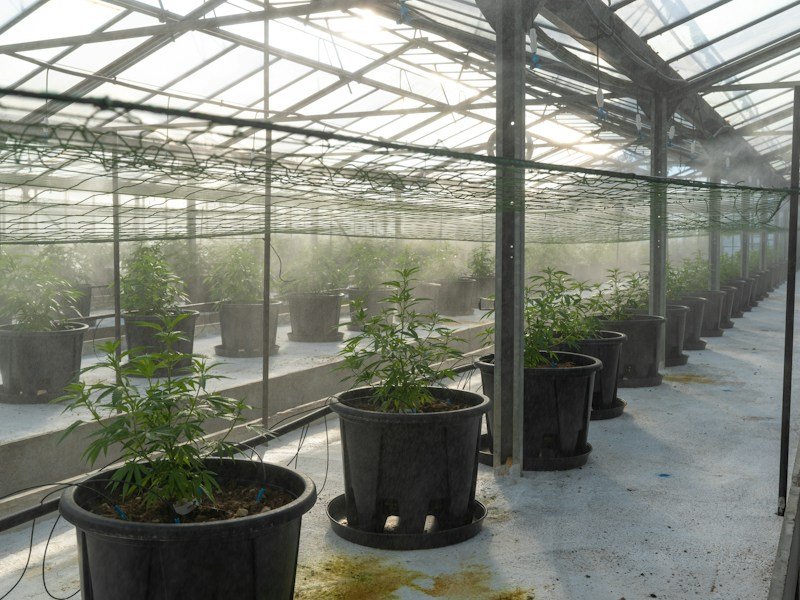
The delivery method changes the practical answer to how often to water grow bags as much as the climate does. Hand watering with a wand delivers large volumes quickly, so crews typically water once per day and accept a wide moisture swing. Drip systems with pressure-compensating emitters deliver precise volumes and make two or three smaller events per day practical. Pulse irrigation, meaning several short events spread across the day, keeps substrate moisture within a narrow band and is standard practice in high-value greenhouse crops.
Which one is right depends on crop value, labor cost, and the uniformity the crop demands. A nursery producing landscape shrubs can tolerate a daily hand-watering pass. A greenhouse producing fresh-market tomatoes or a controlled-environment cannabis facility cannot, because the difference between 50 and 70 percent VWC shows up directly in fruit size, uniformity, and cannabinoid consistency.
If you are moving from hand watering to drip, plan the transition over two weeks. Start with the same total daily volume split into two events, watch runoff and EC for five days, then adjust. Cutting over abruptly to small, frequent pulses often leaves established plants short of water because the wetted volume never fully recharges the lower root zone.
Capillary mats and sub-irrigation are a third option, particularly for small bags and propagation. They keep moisture highly uniform and reduce foliar wetting, but they demand a media with good capillary rise and careful salt management, since leaching is limited by design.
Numbers from operating farms are more useful than rules of thumb, so here are three scenarios from projects we have worked on or audited directly.
A 30,000 square foot greenhouse in the Southeast produces determinate tomatoes in 10-gallon fabric bags filled with a 70:30 coco-perlite blend. At transplant in March, one irrigation event per day at 0.7 gallons per bag held VWC near 62 percent. By late May, with fruit set underway and daily light integral above 22 mol, the same bags were hitting the 45 percent trigger by 1:00 pm. Container Vegetable Gardening for Beginners: A Commercial Buyer's Guide
The fix was a second event at midday at 0.5 gallons, taking total daily use to roughly 1.2 gallons per bag. Runoff rose from 4 percent to 14 percent, runoff EC dropped from 3.4 to 2.1 dS/m, and the crop finished with a 9 percent yield increase over the previous season. The critical insight was that the original schedule was not wrong in spring. It simply never got updated for the season.
An outdoor operation in the high desert of Colorado runs 4,000 plants in 25-gallon fabric bags with a field soil and compost blend. In June, bags needed one deep event every other day at 2.5 gallons. By late July, frequency moved to daily, and during a two-week stretch above 95 F the crew added a 1-gallon pulse at 11:00 am for the bags on the windward edge of the field.
That windward detail mattered. Bags on the exposed edge dried roughly 30 percent faster than interior bags, and the operation had historically lost plants on the perimeter. Splitting the field into two irrigation zones based on wind exposure solved a problem that no single schedule could have fixed.
A wholesale nursery rooting perennial cuttings in 1-gallon fabric bags found that hand watering twice daily was producing uneven results, with heavy losses on the top shelf where airflow was strongest. Installing a capillary mat under the bags and moving to a single misting cycle plus one drip event cut labor by roughly 40 hours per week and improved uniformity across the bench. The lesson: small bags in high-airflow environments often do better with a different delivery method, not just a different frequency.
| Bag Size | Substrate | Crop Stage | Typical Frequency (Warm Season) | Water per Event | Notes |
|---|---|---|---|---|---|
| 3 gal (11 L) | Peat / perlite | Seedling to transplant | Every 2 to 3 days | 0.2 to 0.3 gal | Watch for rapid dry-down in windy tunnels |
| 5 gal (19 L) | Coco coir / perlite 70:30 | Vegetative | 1x per day | 0.35 to 0.5 gal | Pulse twice if runoff EC climbs |
| 7 gal (26 L) | Coco coir / perlite 70:30 | Flowering / fruiting | 1 to 2x per day | 0.5 to 0.7 gal | Second event only if VWC drops below trigger |
| 10 gal (38 L) | Coco / peat blend | Mature, heavy fruit load | 2x per day | 0.6 to 0.9 gal | Standard for greenhouse tomato and pepper |
| 15 gal (57 L) | Coco / perlite with compost | Mature | 2 to 3x per day | 0.8 to 1.2 gal | High VPD days may require a third pulse |
| 20 to 25 gal (76 to 95 L) | Field soil and compost blend | Mature shrubs / trees | Every 1 to 2 days | 1.5 to 2.5 gal | Longer intervals, larger volumes; check moisture at 6 in. depth |
Even a well-built schedule drifts. The fastest diagnosis comes from combining three checks: bag weight, sensor reading, and the plant itself. Wilting at 10:00 am that recovers by evening usually indicates underwatering or a dry pocket inside the bag. Wilting that persists or appears late in the day while the media is still wet points to root problems, not water shortage.
Watch for these signals:
One more commercial consideration: document everything. A simple log of trigger thresholds, event volumes, and weekly runoff readings gives you a defensible record if a crop underperforms, and it shortens the learning curve when you train new staff on the irrigation system.
How often to water grow bags is ultimately a question about how fast your specific system loses water, and every commercial operation has a different answer. The growers who get it right do not rely on a calendar. They measure container capacity, set moisture triggers, push a consistent leaching fraction, and review the data weekly as the crop and the weather change.
If you are specifying grow bags for a new facility, factor irrigation design into the purchase decision. Bag size, fabric density, and drainage construction all affect water use, and choosing a bag that matches your irrigation delivery method is far cheaper than rebuilding a fertigation system around a bag that dries too fast. Ask suppliers for wall thickness and air permeability data, and test a pallet in your own conditions before committing to a full season. How to Start a Garden on a Balcony: A B2B Guide for Suppliers and Property Managers