
Stop Guessing. Start Harvesting.
Stop Guessing. Start Harvesting.
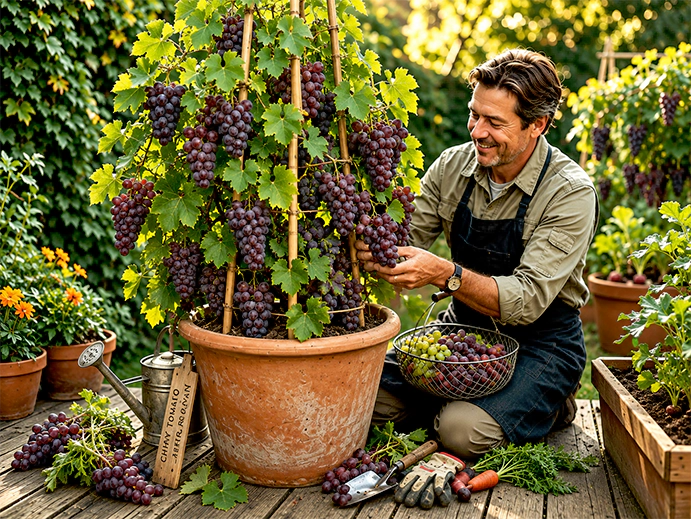
The Ultimate Balcony Grape Masterclass: The 200-Pound Annual Vineyard Blueprint
Welcome to the definitive companion guide for cultivating sweet, heavy-yielding grapes on your sunny balcony, rooftop, or courtyard container garden. Growing grapes from seeds takes up to four years to fruit, but this masterclass short-cuts the timeline by utilizing premium dormant hardwood cuttings to yield agates of jade-colored grapes by the very second year.
You will master advanced vineyard mechanics, including water-node cutting cultivation, single-stem training, the high-precision “final topping” rule, and seasonal structural pruning strategies (Trapezoidal vs. T-Shaped Tree Canopies). Let’s turn your urban container into a massive shade-providing, 200-pound fruiting vine machine!
Class Timeline & Core Modules (Jump to Any Section)
MODULE 1: CULTIVATION FROM CUTTING TO THE TRELLIS 0:00 – Seed Sowing Warning: Bypassing the 4-Year Seed Timeline via Dormant Cuttings 0:40 – Hardwood Cutting Selection: 1-Year-Old Leaf-Free Nodes and Thickness Rules 1:10 – The Root-Node Modification: 3-Node Cuts and Vertical Base Slits for Maximum Water Absorption 1:35 – Moisture Loss Prevention: The Top-Cut Candle Wax Sealing Hack 1:55 – The Hydro-Sprouting Phase: Minimal Water Contact and Root-Cup Transplanting 2:45 – The First Bloom Sacrifice: Pinching Off Early Spring Flower Clusters for Leaf Engine Growth 3:10 – Soil Blending Blueprint: Mixing Roadside Loam, Peat, Perlite, and Decomposed Manure 3:30 – Establishing the Vine: Sheet Straw Mulching and Initial Trellis Wrapping
MODULE 2: PRECISION SUMMER TOPPING & DORMANT WINTER PRUNING 4:00 – The Final Topping Protocol: The Art of Picking the Heart and Bud Digging 4:45 – Photosynthetic Re-allocation: Shifting Sugars to Drive Main Trunk Thickening 5:10 – Trellis Alignment Milestones: The 10-15cm Sub-Shelving Cutting Rules 5:40 – Secondary Lateral Maintenance: Pinching Shoot Tips to Plump Winter Buds 6:10 – Year-One Dormant Clean-Up: Striping Secondary Stems Down to a Single Trunk Bud 6:30 – Autumn Base Fertilization: The Crucial September-October 80% Nutritive Trenching Lifecycle 7:10 – The Alternating Root Pruning Technique: Cutting Old Roots for Multi-Directional Regeneration 8:15 – Fruit Thinning and Balance: The “One Cluster Per Fruiting Branch” Structural Maximum
MODULE 3: HIGH-YIELD CANOPY TRAINING SHAPES (NO TRELLIS VS. ROOFTOP SHADE) 9:00 – Shape A: The Trapezoidal Trunk Canopy System for No-Trellis Sunny Balconies 9:35 – Bending and Fixing: Shaping the Horizontal T-Bar Branch Framework 10:10 – The Solstice Hydration Rule: Softening Vines with Deep Water Pruning Preps 10:45 – Pathogen Shielding: Strict Rules for Dry-Day Pruning to Avoid Wet Fungus Invasions 11:15 – Shape B: The Roof and Yard T-Shape Canopy System for Multi-Year Overhead Shade 12:00 – The Long-Branch Forward Extension Rule for Full Trellis Blanket Coverage 12:35 – Age and Caliper Diagnostics: Determining Branch Loads Based on Tree Stamina 13:10 – Case Study Showcase: Cultivating 200 Pounds of “Red Balado” Grapes in Five Years
MODULE 4: UNIVERSAL HOMEMADE ORGANIC SOIL RECIPE 13:50 – The Root Cause of Potted Plant Death (Why roadside soil turns hard as stone) 14:35 – Building a Premium Compost Bin at Home (Faucets, screen meshes, and drainage logic) 15:40 – The 30-Day Layering Technique (Dry leaves, eggshells, and the perfect turning schedule) 17:15 – Sifting Loam & Debris Extraction for Optimal Root Expansion 17:55 – The Golden Potting Ratio (2 Parts Soil : 1 Part Compost : 0.5 Part Coal/Coconut Coir : 0.25 Part Sand) 19:45 – The 24-Hour Solar Sterilization Protocol for Soil Cleansing 20:20 – Natural Sterilization Hack (Using cinnamon powder to kill bacteria, fungi, and hidden pest eggs)
MODULE 5: 100% NATURAL PEST CONTROL & TRACE MINERAL RECOVERY 21:05 – The Non-Chemical Garlic-Chili Insect Repellent Recipe (Ginger, garlic, hot peppers, and white wine) 22:05 – The 15ml Dilution Rule: Protecting Fragile Foliage from Leaf Burn 22:40 – Live Bug Test: Real-Time Soft-Bodied Pest Immobilization 23:20 – The 5 Essential Growth Factors & Plant Nutrition Science (Understanding N-P-K) 24:30 – 12 Free Homemade Phosphorus & Potassium Boosters (Reusing fruit and vegetable peels) 25:10 – Plant Nutrition Vectors: Photosynthesis, Sugar Accumulation, and Stem Lodging Resistance 25:55 – Ultimate Potassium King: The Banana Peel Liquid Fertilizer Formula (0-3-41 NPK Ratio) 27:00 – Trace Element Profiles of Cucumber, Orange, Potato, and Apple Peels (Calcium, Magnesium, Zinc, Iron) 27:50 – High-Permeability Powdered Peanut Shell Blends for Superior Soil Aeration 28:30 – High-Efficiency Mineral Water Bottle & Milk Jug Fermentation Hacks (Gas-releasing safety techniques) 30:00 – Long-Term Storage Method: Storing Concentrated Liquid Gold Over Winter to Save Hundreds of Dollars Next Spring
There is nothing quite like the pride of harvesting your own vibrant, fiery chili peppers right outside your door. Whether you want a mild crunch or an intense, tongue-scorching heat, you do not need an expansive farm to become a chili master. Learning how to grow organic chili peppers in pots and small yards is one of the most efficient ways to maximize space, customize your soil ecology, and produce a continuous harvest of colorful, pesticide-free peppers.
Chili plants are naturally compact, making them the absolute perfect candidates for urban gardening. In this comprehensive guide, we will break down the exact steps to take your chilis from seed to a spectacular, spicy harvest.