Stop Guessing. Start Harvesting.
A practical, numbers-first guide for growers, nursery managers, and landscape contractors on how to use baking soda for plant fungus — the correct concentration, the surfactant that makes it work, the phytotoxicity ceiling most advice ignores, and the situations where it fails outright.
Walk into almost any production greenhouse or container nursery in the United States and you will find a box of baking soda on the shelf next to the pruners. It has been there for decades. Yet the question our team still fields most often from growers, nursery managers, and landscape maintenance contractors is the same one we heard twenty years ago: how to use baking soda for plant fungus without scorching foliage, wasting labor hours, or chasing a disease it was never designed to control.
The short answer matters to anyone signing a purchase order. Sodium bicarbonate is a preventive contact protectant. It works against a narrow band of surface diseases — powdery mildew, rose black spot, and the earliest stages of some leaf blights — and it works only when three variables line up: concentration, spray timing, and surfactant. Get any one of those wrong and you will still spend the money, still burn the labor, and still lose the crop. Organic Pest Control Secrets: Excerpts From Our Premium Video Course
This guide is written for operations that buy in bulk, run spray schedules across acres or benches, and need to justify every input against a cost-per-acre or cost-per-thousand-plants number. We will cover what sodium bicarbonate actually does at the leaf surface, the five-step protocol we recommend for commercial use, the phytotoxicity ceiling that most home-garden advice glosses over, and the hard limits where a thirty-dollar bag of bicarbonate is simply the wrong tool.
Baking soda treatment for plant fungus is the practice of applying a diluted sodium bicarbonate (NaHCO3) solution as a foliar spray — typically 1 to 2 tablespoons per gallon, or roughly 0.4% to 0.8% by weight — to suppress fungal spore germination on the leaf surface. It is a contact protectant, not a systemic cure: the residue must already be on the tissue when the spore lands, and the material does not translocate into the plant.
Procurement matters here more than most growers expect. The same compound is sold as food grade (FCC/USP), agricultural grade, and technical grade, and the difference shows up in dissolution rate, caking behavior in bulk storage, and the heavy-metal and chloride specifications your QA team will ask about. Food-grade material at 99.5%+ purity is what most nurseries standardize on because it dissolves cleanly and will not plug a nozzle at 100 mesh filtration.
When sodium bicarbonate dissolves, it raises the pH of the water film on the leaf surface to roughly 8.2 to 8.4. That shift alone is enough to inhibit germ tube formation in several powdery mildew species, which is why the material has shown measurable suppression in university trials even where no true fungicidal activity exists. The bicarbonate ion also interferes with the osmotic and ionic balance at the infection site, which appears to delay rather than destroy the pathogen.
That distinction drives everything downstream. Baking soda does not kill established colonies, does not cure existing lesions, and does not protect tissue that was never sprayed. Its value is in the window between spore landing and penetration — a window measured in hours, not days. If your program treats baking soda as a rescue product, it will underperform and you will blame the material instead of the timing.
Setting expectations correctly at the planning stage is the difference between a program that pays for itself and one that does not. Based on trial data and field reporting, here is the practical range:
If your scouting report says downy mildew, stop reading the baking soda label and open the oomycete section of your chemical plan instead. Mid-Summer Maintenance Checklist for High-Yield Patio Gardens
The protocol below is the sequence we walk commercial clients through. It is deliberately ordered, because skipping Step 1 is the single most common reason a bicarbonate program fails.
Scout with a 10x to 14x hand lens and confirm what you are looking at. Powdery mildew sits on the upper leaf surface as a talcum-like white film and rubs off on your finger. Downy mildew typically appears as angular yellow patches bounded by veins with grayish sporulation underneath, and it will not respond to bicarbonate at all. Spider mite feeding and thrips damage are routinely misdiagnosed as fungal lesions by seasonal staff.
Not all sodium bicarbonate dissolves the same way. Fine-mesh food grade dissolves in under a minute at 70°F with moderate agitation; coarse agricultural material can leave grit that settles in the tank and wears pump seals. For most operations running backpack sprayers, boom sprayers, or bench-mounted booms, food grade at 99.5% minimum purity is the correct specification.
This is where most programs go wrong. The published research range for useful suppression is 0.5% to 1.0% by weight. In practical terms, one level tablespoon of baking soda per gallon of water lands near 0.4%, and two tablespoons lands near 0.8%. Many experienced growers run 1 tablespoon plus a surfactant for sensitive crops and step up to 2 tablespoons only after a patch test.
Bicarbonate is a protectant with limited rainfastness. Expect it to wash off after roughly half an inch of rain or overhead irrigation, which sets your re-application interval as much as the disease cycle does. Spray early morning or after sunset, when stomata are open and drying is slow; mid-day applications above 85°F dramatically increase the burn risk, especially on thin-leaved crops.
Sodium bicarbonate has a real phytotoxicity ceiling, typically around 1% on most tolerant crops and much lower on sensitive ones. Before any block-wide application, spray 10 to 20 representative plants at the planned rate and inspect at 24 and 48 hours for marginal necrosis, speckling, or leaf curl. Keep the test block data with your spray records. Foolproof Guide to Growing High-Yield Cucumbers at Home
| Option | Primary Mode of Action | Typical Use Rate | Best Against | Indicative Material Cost per Acre per Application | Key Limitation |
|---|---|---|---|---|---|
| Sodium bicarbonate (baking soda) | Contact protectant; raises leaf-surface pH | 1–2 tbsp/gal (0.4–0.8%) plus surfactant | Powdery mildew, rose black spot, early blight | $7–$12 | No systemic or curative activity; phytotoxicity above ~1%; sodium load in container media |
| Potassium bicarbonate | Contact protectant; pH shift plus osmotic effect | 1 tbsp/gal (0.5–1%) | Powdery mildew, Botrytis, black spot | $35–$60 | Three to five times the material cost; still contact only |
| Horticultural oil (mineral or neem) | Suffocant; disrupts spore adhesion and insect life stages | 1–2% dilution | Powdery mildew, scale, mites | $25–$50 | Phytotoxicity risk in heat and full sun; visible residue |
| Copper hydroxide | Multi-site contact protectant | Label rate, typically 1–2 lb metallic copper per acre | Bacterial spot, blights, downy mildew | $20–$45 | Staining, crop sensitivity, re-entry interval, resistance stewardship |
| Sulfur | Multi-site contact | 3–5 lb per acre | Powdery mildew, rust, mites | $15–$30 | Heat sensitivity above 85°F; do not tank-mix with oils |
| Systemic DMI (e.g., myclobutanil) | Systemic sterol biosynthesis inhibitor | Label rate | Powdery mildew, rust, scab | $40–$90 | Resistance risk; strict rotation and application-count limits |
A Pacific Northwest nursery holding roughly 12,000 container roses was spraying a protectant every 10 days and still losing leaves to black spot by early July, with defoliation running near 30% on the most susceptible cultivars. We moved them to a 0.8% bicarbonate solution with 0.1% nonionic surfactant, applied weekly at first light, and layered in two sanitation changes: removal of fallen leaf litter and a switch from overhead to drip irrigation on the affected benches.
Material cost landed at roughly $7 to $9 per acre per application at bulk pricing, with about half an hour of labor per acre. Over a 14-week season, the full bicarbonate program ran under $40 per acre-application all-in including labor and equipment depreciation. Lesion expansion slowed measurably by week three, and defoliation on the treated block dropped to under 12%. The program was not used alone — every third application was rotated to a registered systemic DMI — but it displaced four conventional sprays and paid for itself in reduced material spend and recovered plant grade.
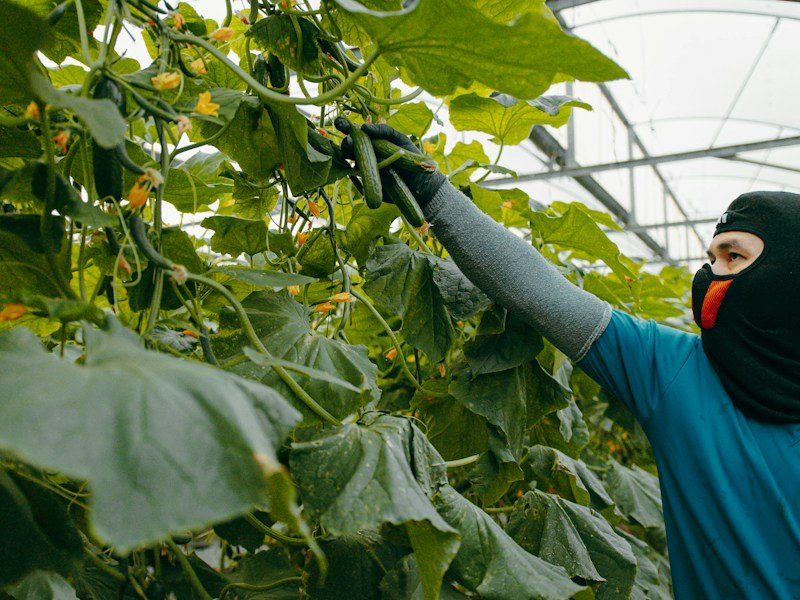
A 30,000-square-foot cucumber house came into late winter with powdery mildew spreading along the row ends nearest the fans. The initial instinct was to escalate chemical rates. Instead we ran three parallel inputs: 0.5% bicarbonate with surfactant every 6 days, a nighttime humidity reduction that brought the VPD into range, and removal of the two worst rows as a sanitation write-off. The mildew front stalled within ten days.
The useful lesson was economic. Bicarbonate cost about $11 per application for that house, against $190 for a full-rate systemic application. The greenhouse did not get a clean crop from baking soda alone — it never does — but it bought two weeks of suppression at roughly 6% of the cost, which was exactly the window needed to finish the harvest.
Forty acres of field tomatoes in the Central Valley entered a warm, humid stretch with early blight pressure climbing. The grower wanted an all-bicarbonate approach for cost reasons. It did not hold. Bicarbonate at 0.8% applied every 5 days suppressed new lesion development on the upper canopy, but the material washed off after 0.4 inches of irrigation and provided no protection on the lower canopy where the inoculum load was highest.
The reality is that a contact protectant on an open field crop with high inoculum pressure is a losing proposition. The final program used bicarbonate as an early-season bridge and rotated to a multi-site protectant once canopy closure made coverage impossible. That is the correct use of the tool: a low-cost bridge, not a foundation. How to Use Cinnamon for Plant Root Rot: Commercial Grower Guide
Every gallon of 0.8% solution carries roughly 0.23 pounds of sodium. Applied weekly to a container crop across a full season, that adds up in a closed system. In-ground production leaches readily and rarely shows a problem; container and greenhouse production does not have that luxury.
Residue on harvested produce is not a meaningful concern for food safety — sodium bicarbonate is a GRAS substance and rinses clean — but the sodium itself is a real agronomic input that belongs in your fertility accounting.
For commercial buyers this point is not academic. Sodium bicarbonate is not an EPA-registered pesticide, and no product may be sold with disease-control claims on the label without registration under FIFRA. Growers use it as a management practice at their own discretion, and state lead agencies vary in how they treat the practice. What you should not do is repackage bulk bicarbonate with disease-control language, or advertise a bicarb-based blend as a registered fungicide. If you need a labeled, registered product with a defined rate and residue tolerance, potassium bicarbonate is the registered alternative and it performs comparably at roughly three to five times the material cost.
If bicarbonate is going to be a standing line item in your spray program, buy it like an input, not like a grocery item.
There is no shame in leaving the box on the shelf. Choose a different product when any of the following is true:
Used inside those boundaries, sodium bicarbonate is one of the cheapest, safest, and most reliable tools a commercial operation has. Used outside them, it is a line item that produces spray records and nothing else. Balcony Gardening Masterclass: A B2B Playbook for Property, Retail, and Hospitality Teams