Stop Guessing. Start Harvesting.
Stop Guessing. Start Harvesting.
A production-grade guide to how to grow raspberries in pots, written for growers, nursery managers, and buyers. Covers cultivar class selection, container and media specification, fertigation schedules, cane management, overwintering, and the case numbers behind a profitable container raspberry program.
If you are working out how to grow raspberries in pots at commercial scale, here is the short version: raspberries finish well in containers when you match cultivar class to container volume, hold the root zone between 60°F and 75°F, and feed the crop through fertigation rather than dry granular programs. Everything else — trellising, chill hours, winter protection, sell-through timing — becomes a scheduling exercise you can plan around instead of a risk you absorb at the end of the season.
The question keeps surfacing in buying offices and production meetings for a simple reason. Patio fruit has moved from a novelty table at the independent garden center to a standing category with its own planogram. A 5-gallon raspberry in pink bud, priced between $12.95 and $16.95 at retail, turns faster than most flowering shrubs and carries a better margin than a flat of annuals. Buyers want it in April and May, ship-ready, with a two-week shelf life under overhead irrigation. Growers who hit that window consistently keep the account. Easiest Fruit to Grow in Pots on a Balcony: A Commercial Buyer's Guide
We have built container raspberry programs ranging from 4-inch liners for mail-order to 25-gallon specimen pots for landscape contractors, and the failure pattern is remarkably consistent. Programs rarely die from the wrong cultivar. They die from undersized containers, uneven drip emitters, salt accumulation in a shallow root zone, and a forcing schedule that pushes plants into flower two weeks before the truck arrives.
This guide covers the commercial mechanics in the order you will actually make the decisions: cultivar class, container and media specification, irrigation and fertility, canopy and crop timing, then overwintering and sell-through. The numbers come from production records across USDA Zones 4 through 8.
Definition: Growing raspberries in pots is the practice of producing Rubus idaeus in a contained root volume — typically 3 to 25 gallons — using a formulated growing medium, controlled irrigation, and a scheduled nutrient program. In commercial settings the term covers three distinct business models, and each carries different economics, labor profiles, and risk.
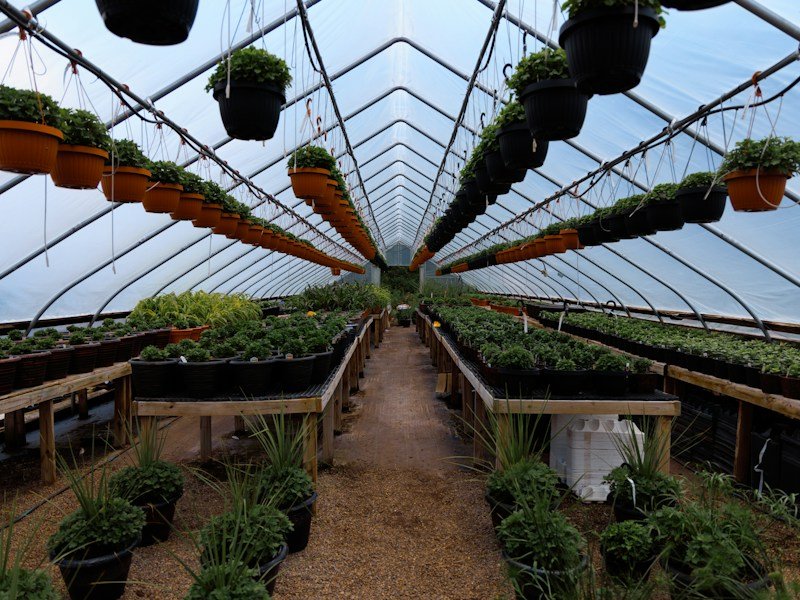
Dormant liners are potted in late winter, forced for 6 to 10 weeks, and shipped in bud or early flower. The governing metric is revenue per square foot of greenhouse per week, not yield per plant. A well-run 5-gallon program turns a bay in 14 weeks and books wholesale prices between $8.50 and $11.00 per unit against a finished cost near $4.00.
Larger pots, 15 to 25 gallons, held for three to five seasons and harvested for market, u-pick, or restaurant accounts. Capital intensity is higher and the crop competes with field plantings on cost per pound, but containers solve drainage, nematode, and replant problems and let you place production on pavement, rooftops, or ground that would never pass a soil test.
Tissue culture or root cuttings established in 4-inch to 1-gallon containers and sold to field growers or other nurseries. Margins are thinner per unit but volume is high and the cycle is short — often 10 to 14 weeks from plug to shipping liner.
Most operations that succeed at container raspberries run one of these models cleanly before layering a second. Blending a retail forcing program with a fruit production block in the same house usually ends with the retail plants shading out the fruiting rows or with a spray calendar that conflicts with the ship date.
The single highest-leverage decision is whether you are running a floricane (summer-bearing) or primocane (fall-bearing) program, because it determines whether you must overwinter the crop at all. Best Fruit Bushes for Small Spaces: A Commercial Buyer's Guide for 2025
Three practical checks before you commit a purchase order. First, confirm plant variety protection status: several newer cultivars carry PVP or utility patents, and propagation without a license is a legal exposure, not a paperwork nuisance. Second, buy certified virus-indexed stock — raspberry bushy dwarf virus and tomato ringspot will follow a cheap root cutting through an entire production block. Third, match chill accumulation to your actual site. A primocane cultivar still needs roughly 4 to 6 weeks at 35°F to 40°F for uniform bud break if you are forcing early; skip the cold treatment and you get uneven emergence and a split ship date.
Container and media are one decision. A 5-gallon pot with a field-soil blend will waterlog, suffocate roots, and produce a plant that looks acceptable on the bench and collapses in the retail yard.
Volume guidance by program: 1-gallon for liners, 3-gallon for entry-level patio SKUs, 5 to 7-gallon for the core retail product, and 15 to 25-gallon for multi-season fruit production. Rasberries are shallow-rooted and unforgiving of a small root volume in July; a 3-gallon plant in Zone 7 will need irrigation twice daily at peak, while a 15-gallon plant on the same schedule holds a far more stable moisture curve.
A media specification that has performed consistently for us: 70 to 80 percent aged pine bark, 15 to 20 percent peat or coir, and 5 to 10 percent perlite by volume, with dolomitic lime to land at pH 5.8 to 6.5. Target air-filled porosity above 25 percent. Bark fines below 3/8 inch are preferred because they hold together through a shipping cycle without packing.
Container selection matters more in the South than the North. Black HDPE pots in full sun in Zone 7 can push the root zone past 95°F by mid-afternoon, which is where Phytophthora pressure becomes lethal. White or light-colored containers, pot-in-pot placement, or shade cloth on the south face will pull the root zone down 10 to 15°F. Fabric grow bags work well on rooftops and for u-pick, but budget for two to three seasons of service life rather than five.
Spacing: 18 to 24 inches on center for 5-gallon pots, 30 to 36 inches for 15-gallon, plus aisle width for a cart. Crowding a retail house to gain 8 percent more units usually costs more in botrytis and uneven coloring than it returns.
Container raspberries fail on salt accumulation far more often than on nutrient deficiency. There is no subsoil to buffer an over-application, and raspberries are notably sensitive to chloride, sodium, and boron. Small Backyard Fruit Garden Design: A Complete B2B Guide for Landscape and Nursery Professionals
Check media pH and EC weekly with a pour-through test, and check emitter uniformity monthly. A clogged emitter in a 5-gallon pot is invisible until the plant wilts at 1 p.m. and never recovers. We run a simple flow test on 10 emitters per zone each month and replace the whole lateral when variance exceeds 15 percent.
Cane density and tipping control both yield and ship date. For retail product, target 5 to 8 canes in a 5-gallon pot and 12 to 18 in a 20-gallon pot. More canes than that produces a crowded plant with small fruit and poor air movement.
For primocane types in a retail program, pinch the growing tips at 24 to 30 inches to force branching — that single operation is what separates a plant that ships with three fruit clusters from one that ships with eight. Stop pinching roughly 60 days before your target ship date so the new growth has time to set bud.
Trellising: a T-post and two-wire system at 36 and 42 inches covers a 15 to 25-gallon production block. In retail pots, a single 36 to 48-inch bamboo stake and two soft ties is sufficient and ships without damage. Do not over-tie; canes need a little movement to build caliper.
Canopy management also drives disease. Raspberry botrytis loves still air and spent flowers. Remove spent floricanes immediately after harvest, keep aisles clear, and run horizontal airflow in the greenhouse. In tunnels, a 20 to 30 percent shade cloth during the July heat spike reduces sunscald on fruit without stretching canes.
Raspberry roots are hardy in the ground to roughly 0°F to minus 10°F depending on cultivar. In a container, assume two USDA zones less hardiness, because the root ball freezes from all sides and cannot draw on soil heat. A Zone 4 field planting becomes a Zone 6 container risk.
Overwintering options, in rough order of reliability:
Harden off for 7 to 10 days before shipping or setting out. Plants forced under 70°F greenhouse conditions and moved straight to a retail bench in April will burn and drop leaves in 48 hours, and that shrink lands on your invoice, not the retailer’s. Urban Balcony Food Forest Blueprints: A Commercial Design Guide for Developers
For the retail calendar, work backward from the ship week. Ten to fourteen weeks from potting to a 5-gallon plant in bud is a realistic forcing window in a 60°F to 68°F house. Build a two-week buffer. Every grower who has missed a Mother’s Day truck once builds the buffer permanently afterward.
| Container Size | Typical Cultivar | Canes per Pot | First-Season Yield | Retail-Ready Timeline | Best Commercial Use |
|---|---|---|---|---|---|
| 4-inch to 1-gallon liner | Heritage, Caroline | 2 to 3 | 2 to 4 oz | 10 to 14 weeks from plug | Mail-order and field-plant liners |
| 3-gallon | Joan J, Anne | 3 to 5 | 6 to 10 oz | 10 to 14 weeks from potting | Entry-level patio SKU |
| 5-gallon | Heritage, Caroline, Double Gold | 5 to 8 | 10 to 16 oz | 12 to 16 weeks from potting | Core retail patio program |
| 7-gallon | Joan J, Fall Gold | 6 to 10 | 14 to 22 oz | 14 to 18 weeks from potting | Premium patio and gift trade |
| 15-gallon | Caroline, Heritage | 10 to 14 | 1.0 to 1.5 lb | One full growing season | Container fruit and u-pick |
| 20 to 25-gallon | Tulameen (floricane), Caroline | 14 to 20 | 1.5 to 2.5 lb by second season | Second season | Landscape and rooftop production |
Case 1 — Michigan, 14,000-unit retail forcing program. A 30 by 72-foot high tunnel operation potted dormant Heritage roots into 5-gallon containers in early February and forced in a 62°F house. Finished cost landed at $4.10 per unit, including liner, media, pot, labor, and heat. Wholesale averaged $9.25 across three independent garden center accounts; retail was $14.95 to $16.95. Shrink ran 4 percent, all of it from plants held past week 16 in the tunnel. The lesson from year one was not agronomic — it was that the last 800 units cost more in holding than they returned in margin. They now contract 90 percent of the crop forward.
Case 2 — Ohio, 900-pot container fruit block. A rooftop urban farm used 15-gallon fabric pots with Caroline in a 70/20/10 bark-peat-perlite blend, drip irrigated, no winter protection beyond clustering and straw mulch. First-season yield averaged 1.3 pounds per pot, sold at $6.50 per pound through u-pick and two restaurant accounts — roughly $7,600 gross on a 900-pot block in year one, with full capital recovery projected in year two. The pots that underperformed were all on the western edge of the array, where root zone temperatures ran 12°F higher. They added a shade panel and the year-two numbers flattened out.
Case 3 — Oregon, 60,000-liner propagation contract. Tissue culture plugs moved to 4-inch pots, then to 1-gallon, on a 12-week cycle supplying 40 independent garden centers. Sell-through at retail hit 92 percent when the liners shipped at 8 to 10 inches with two visible canes. Anything shorter sat. The operation cut its production of 4-inch single-cane liners by half after year one; the smaller grade was a false economy once retail labor costs were factored in.
A failure worth repeating. A 2021 trial in Zone 7 used 10-gallon black pots in full sun with a dry granular fertilizer program and no leaching. Root zone temperatures peaked at 98°F in July, EC climbed past 3.5, and the block lost roughly 30 percent of plants to Phytophthora root rot by September. The fix was not a fungicide: it was light-colored pots, a leached liquid program, and a shift of the production block to morning sun with afternoon shade. Total cost of that lesson was about $6,800 in lost inventory and a season of greenhouse space.
The pattern across all four examples is the same. Container raspberries are a scheduling and root-zone business. Cultivar choice sets the ceiling, but container volume, irrigation uniformity, leach fraction, and ship-date discipline determine whether you actually reach it. Growing Potted Raspberries in Small Spaces: A Commercial Grower's Guide