Stop Guessing. Start Harvesting.
Stop Guessing. Start Harvesting.
Do you look at your limited balcony or patio space and wonder how commercial growers manage to squeeze massive yields out of tiny footprints?
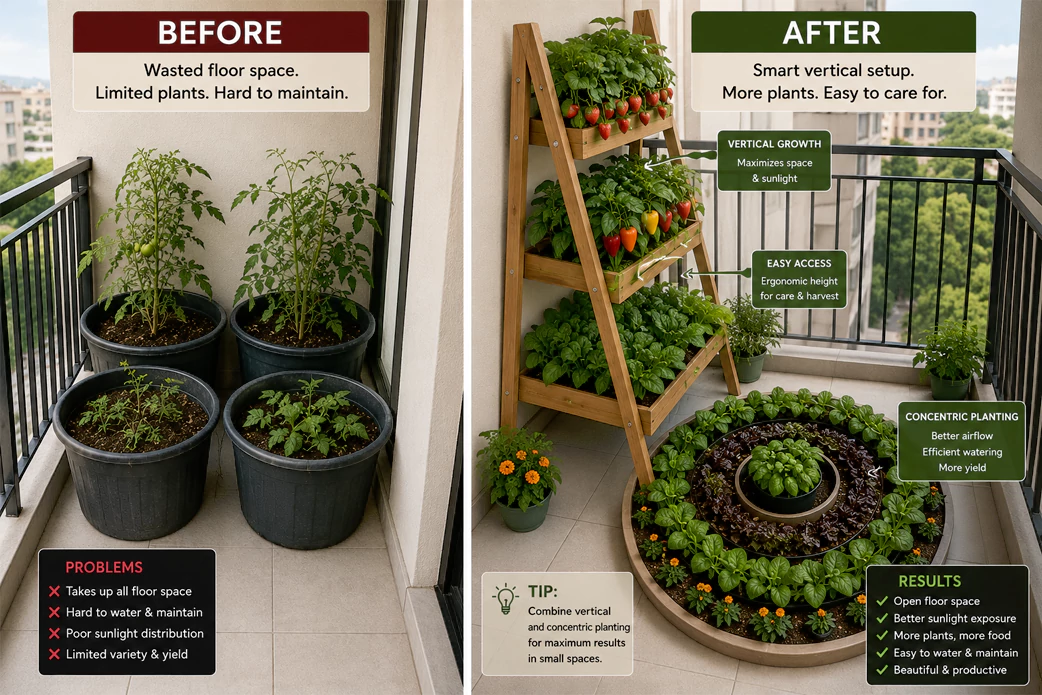
Many beginner urban gardeners fall into the trap of arranging their pots in simple, flat rows across the floor. While this looks organized, it completely wastes the upper air space and leaves valuable soil pockets empty. If you want to scale up your home food production without cluttering your living area, you need to transition from basic arrangements to advanced geometric spacing layouts and tier design parameters.
By applying precise spatial geometry and multi-level vertical structuring to your container ecosystem, you can optimize light interception, improve root distribution, and significantly increase your seasonal output.
Advanced geometric spacing layouts utilize close triangular configurations (hexagonal staggering) instead of square grids to fit up to 14% more plants per container. Pairing this with tier design—structuring pots vertically on multi-level stands based on canopy height and sunlight requirements—allows you to maximize crop density and utilize 100% of your vertical square footage.
Traditional garden layouts rely on open-field instructions, which assume land is abundant. When these linear spacing rules are forced into a small apartment or patio container setup, efficiency drops.
The five most common layout flaws in small-space gardening include:
Implement these advanced engineering principles to restructure your containers and maximize your small-space spatial efficiency.
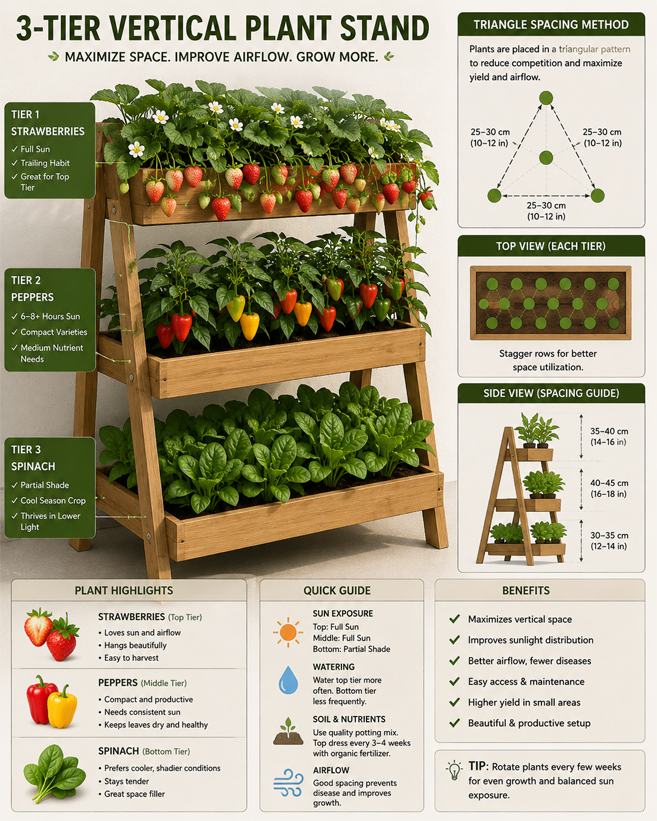
Instead of planting seeds or seedlings in a standard square grid, align them using an equilateral triangular pattern. In this layout, every plant in the second row is offset to sit perfectly in the center gap of the plants in the first row. This hexagonal configuration keeps the distance between all plants completely equal, allowing you to increase your plant density by 14% without crowding root zones.
When designing a multi-level vertical tier stand, always group and place your crops based on their mature structural habits and light tracking parameters:
For large round containers (such as 10-to-15-gallon half-barrels or large fabric grow bags), utilize a concentric circle spacing layout. Place a single, deep-rooted, tall heavy-feeder (like a determinate patio tomato) in the absolute center. Surround it with a middle ring of medium-root herbs (like bush basil), and finish with an outer perimeter ring of fast-harvest root vegetables (like globe radishes).
If you are building or buying a tiered vertical structure, avoid perfectly vertical shelving units that mimic standard indoor bookcases. Instead, choose a stepped A-frame design or a ladder shelf configuration. The angled offset ensures that as the sun moves across the sky, upper shelves do not cast complete, unbroken shadows over the lower steps.
To completely clear your main floor space for heavy, multi-tier systems, shift your fast-growing salad crops to the perimeter. Utilize heavy-duty brackets to mount long rectangular window boxes along the outer face of your railings. This opens up clear floor pathways for advanced High-Yield Container Gardening setups without sacrificing walking space.
Keep these structural and environmental boundaries in mind to protect your intensive container setup:
Utilizing specialized structural tools makes setting up and maintaining a multi-tier geometric garden organized, balanced, and highly efficient.
| Tool | Why It Helps |
| Stepped A-Frame Plant Stands | Creates a natural staggered angle to ensure all lower shelves receive adequate sunlight. |
| Equilateral Planting Templates | Takes the guesswork out of seed sowing by marking perfect triangular spacing patterns instantly. |
| Lightweight Fabric Grow Bags | Reduces structural weight loads on vertical shelves while ensuring optimal root aeration. |
| Slatted Shelf Liners | Allows air and light to pass through tiers easily while preventing water pooling. |
Liam, an architecture student living in a metropolitan apartment with a compact 5×5 recessed balcony, wanted to grow his own fresh ingredients but felt trapped by the small square footage.
Row spacing places plants directly behind one another in a square or rectangular grid, creating empty corners of unutilized soil. Triangular spacing offsets every other row, fitting plants into those empty gaps. This geometric shift maximizes your available soil surface area, allowing for higher plant density without crowding the roots.
To minimize shadowing, always position your tiered plant stands facing directly south or west to capture maximum tracking light. Additionally, utilize a stepped or angled ladder design rather than a flat bookcase structure, and place your lowest-light crops (like kale or spinach) on the bottom tier, as outlined in our Best Vegetables For Small Balconies guide.
Yes, this is an excellent high-yield practice known as intercropping. The main parameter is matching complementary root structures and growth timelines. Pair deep-rooted, slow crops with shallow-rooted, fast-growing varieties. Avoid grouping multiple heavy-feeding plants together in tight configurations, a common trap covered in our How To Start A Balcony Vegetable Garden For Beginners setup blueprint.
Yes. Wet soil, water reservoirs, and heavy containers accumulate weight quickly. To keep your vertical setup safe and stable, always choose lightweight fabric or resin pots, use lightweight potting mixes rather than topsoil, and place your heaviest containers on the lowest shelf closest to the balcony floor.
High-density planting exhausts soil nutrients rapidly because multiple root systems are working within a fixed volume of space. Mix a high-quality slow-release organic fertilizer into your potting medium at planting time, and follow up with a mild water-soluble liquid fertilizer every 10 to 14 days throughout the active growing season, a management style detailed in our Balcony Gardening Mistakes reference sheet.
Stop wasting valuable vertical space. Download our free advanced layout blueprint and master the art of high-density geometric container configuration.
Download our free resource today and receive:
[Info@yardveggie.com ]
👉 [ DOWNLOAD YOUR FREE ADVANCED LAYOUT KIT NOW ]
If you want to skip the frustrating trial-and-error cycle and master the exact visual engineering systems used to build high-yielding vertical container gardens, take a look at our structured video series. Our comprehensive Balcony Harvest Masterclass offers an interactive, step-by-step roadmap designed specifically for small-footprint urban living.
Bypass the guesswork with high-definition, practical tutorials covering: