Stop Guessing. Start Harvesting.
Stop Guessing. Start Harvesting.
Do you want to cultivate a high-yielding container garden but find your plants struggling with yellowing leaves, slowed growth, or sudden wilting?
Setting up an urban garden on an elevated balcony or patio offers excellent natural protection against destructive, ground-level soil pests. However, the single biggest obstacle container gardeners face is poor drainage management. When water gets trapped at the base of a pot, it creates a stagnant environment that pushes out oxygen, leading directly to waterlogged soil conditions and destructive fungal root rot.
This guide provides a comprehensive, organic strategy to optimize your growing medium, design an efficient pot layout, and protect your plants’ root health naturally.
To master the art of preventing container waterlogging and root rot organically, bypass dense yard soils entirely. Use a high-porosity soil-less substrate made of 1 part coco coir or peat moss, 1 part coarse perlite, and 1 part organic compost. Combine this with breathable fabric grow bags and elevate your pots on slatted stands to ensure excess water never pools around the root zones.
In an open backyard garden plot, excess water sinks deeply into the earth via gravity. However, inside a restricted plastic or ceramic pot, water encounters a physical boundary known as a perched water table.
A layer of completely saturated soil naturally forms at the very bottom of every container after watering. If your potting soil consists of fine, heavy materials like backyard clay or cheap topsoil, this saturated zone stays thick and muddy, suffocating delicate feeder roots. Over time, the roots starve for oxygen, decay, and invite harmful water molds. To fix this organically, you must build structural air pockets directly into your soil recipe.
A healthy container medium requires physical aggregates that do not break down over time. Incorporating coarse materials like perlite, pumice, or expanded clay creates permanent structural channels (macro-pores) that allow excess water to rush through while keeping vital oxygen flowing to the root system.
Traditional plastic containers seal your root zones away from the outside atmosphere. In contrast, non-woven fabric grow bags allow air to enter the container from 360 degrees. This extra ventilation accelerates evaporation from the outer edges and naturally “air-prunes” the roots, preventing them from circling tightly and locking out moisture.
When a flat-bottomed container sits directly on a smooth concrete balcony or patio floor, water tension forms a tight seal that traps moisture inside the base drainage holes. Elevating your containers onto slatted wood benches, wire racks, or plastic pot feet breaks this seal, allowing wastewater to drain freely into collection trays.
To plan your container arrangements efficiently using the layout principles from our Advanced Geometric Spacing Layouts and Tier Design framework, use this targeted setup guide:
| Crop Category | Fungal Vulnerability | Ideal Organic Substrate Mix | Best Pot Type | Layout & Airflow Solution |
| Fruiting Crops (Tomatoes, Peppers) | High | 40% Coir + 30% Perlite + 30% Worm Castings | 5-Gallon Fabric Grow Bag | Place on elevated vertical tier frames with wire mesh shelves. |
| Vining Crops (Cucumbers, Squash) | High | 40% Peat Moss + 30% Coarse Perlite + 30% Aged Compost | 5-Gallon Plastic Bucket (Side Holes) | Set over independent overflow trays with a plastic riser grid. |
| Root Crops (Carrots, Radishes) | Medium | 30% Coir + 40% Horticultural Sand + 30% Leaf Mold | Deep Rectangular Trough | Mount onto a slatted waist-high garden bench for bottom aeration. |
| Leafy Greens (Lettuce, Spinach) | Medium | 50% Coco Coir + 30% Perlite + 20% Mushroom Compost | Shallow Window Boxes | Hang directly on balcony railings using angled steel brackets. |
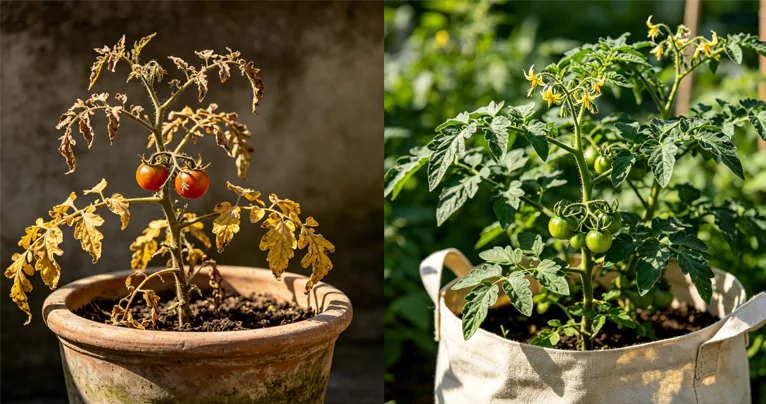
David, a biology student with an east-facing apartment patio, wanted to grow his own cherry tomatoes but ran into immediate plant health problems.
The easiest way to check is to look at the leaves and smell the soil. If your container plant is wilting during cool evening hours when the sun is down, or if its lower leaves are turning a uniform pale yellow while the soil is completely wet, root rot is likely active. Gently pull the root ball out of the pot: healthy roots are crisp, firm, and white, while rotted roots look dark brown, feel mushy or slimy, and emit a distinct, sour odor.
To defend your container roots naturally, utilize beneficial soil microbes. Mix organic bio-fungicides containing strains of Bacillus amyloliquefaciens or Trichoderma into your watering can. These friendly soil organisms act as a natural shield, colonizing the plant’s roots and aggressively outcompeting or consuming harmful water molds without the need for harsh chemicals.
While both are expanded volcanic minerals, they behave differently in soil. Perlite has a hard, glassy structure with microscopic outer cavities that trap air; it does not absorb water internally and helps accelerate drainage. Vermiculite acts like a sponge, expanding into soft flakes that hold water and nutrients tightly. For fixing waterlogged pots, always prioritize perlite or coarse pumice over vermiculite.
There is no single fixed calendar schedule because evaporation rates shift daily based on temperature, wind, and container size, a routine tracked in our How Often Should You Water Container Vegetables? manual. Always check the soil manually: insert your finger two inches deep into the pot. If it feels cool and damp, step away. Only water when the top two inches feel dry to the touch.
It is highly risky. Root rot is caused by opportunistic water molds whose spores can remain dormant inside old, damp soil for months. If you must reuse the potting mix, you need to pasteurize it first. Spread the soil onto a baking sheet, cover it with foil, and bake it in an oven at 180°F (82°C) for 30 minutes to kill off dormant pathogens before remixing it with fresh compost.
Eliminate watering confusion and establish a healthy, well-oxygenated container garden today. Download our free small-space design blueprint.
Download your free kit to access:
[ Info@Yardveggie.com ]
👉 [ DOWNLOAD YOUR FREE DRAINAGE OPTIMIZATION KIT NOW ]
If you want to skip the frustrating trial-and-error cycle of stunted growth and waterlogged containers, discover the layout systems taught in our video series. Our comprehensive Balcony Harvest Masterclass delivers an interactive, step-by-step roadmap built specifically for small-footprint urban environments.
Bypass the guesswork with high-definition, practical tutorials covering: